Saturday, June 30, 2012

July 1, 2012 - Entry on Classes and Hill Tribe Excursion


Tom, Christina Firpo and I, along with all 23 of our students, got back yesterday from the overnight hill trip excursion. It was a high point of the trip. The students have been exhausted by the schedule: lots of class time. They begin each day with a 9am history of Southeast Asia class that goes until 11; then they have an hour break, followed by my literature class from 12 to 2. Their major complaint is that then they have a two-hour Thai language class from 2 to 4.  So they are in class for 6 hours. Two days a week, they have a cultural activity at 4:30 that doesn’t finish until 6:30. The cultural activities are Thai cooking and Muay Thai. These activities were supposed to be 3 hours, but I asked if they could be changed to two hours; then I asked if the Thai language could be changed to one and half hours.  The students told me that after an hour of Thai language they were mumbling incoherent baby syllables to pass as a semblance of Thai. One of the younger Thai female teachers started teaching her class Thai dancing after an hour of language. Needless to say, she is a favorite. These language teachers come impeccably dressed for class and are good natured and professional.

Ours students all wear their skirts and long pants with closed toed shoes to fit the dress code, yet they still look as if they crawled out of bed. We, including us profs, stand out from the rest of the university.  All of the students at Chiang Mai University (20,000 undergrads) wear black skirts or pants and white shirts. The majority of the students at the College of Humanities are Chinese and look as if they are in junior high. Our students look much, much older.

After two weeks of class, we were all ready for a change of scheduled routine, so the one-night trip was welcomed. Krith, Cal Poly’s liaison for the Thai study abroad program, who also organizes all international programs and therefore works constantly, took us on this trip along with Thai drivers in three very nice vans.  We first went to the Cultural Museum in Chiang Mai, an excellent museum, similar in theory to the Vietnamese Museum of Ethnology. Then we drove to a national park that has the highest peak in Thailand. After eating lunch, Krith passed out rain parkas and ponchos for everyone because it was raining (it is the rainy season). We hiked in the mud and I mean mud up a hill to an enclosed hut that they called a museum. We were introduced to a Hmong clan leader and his compatriot, both dressed in their traditional clothes. The Hmong are an ethnic mountain tribe who migrated from China many, many years ago to Laos and then Thailand. They fought for the United States during the Vietnam War. Their involvement in the war was unknown because they were recruited by the CIA to fight in Laos, where American soldiers were not supposed to be. The war in Laos is known as the Quiet War, and 30,000 Hmong were killed. After the war, most of the remaining Hmong people fled to Thailand for safety from the Communists and ended up in refugee camps in Thailand. Those who fought were promised asylum in the US for them and their families. About a 1,000-3,000 were airlifted to America; many were left. As a result, many Hmong live in Thailand and other areas of Southeast Asia.  Historically, they have never had a homeland because they were always a migratory mountain tribe.

In the Ethnic Literature class on Southeast Asia that I am teaching, the students and I had just gotten through reading and studying a non-fiction book on the Hmong people. Therefore, they were well prepared for meeting the Hmong representatives in terms of having some historical knowledge of them. The Hmong clan leader, who was characteristically about five feet tall, held himself with much stature and addressed us using a translator. I was extremely pleased because the students asked such good questions and did not fit the stereotype of ignorant or clueless Americans.
His talk was finished with the other man playing the Hmong musical instrument (a red pipe) called the qeej and dancing as a ceremonial welcome.

Krith had handed me a  white envelope with a donation inside for me to present to the Hmong leader.  In the dark of this shelter with it raining outside, I thanked the two men, bowed, and handed the leader the envelope.

In a parade of colored parkas slipping and sliding down muddy trails, we walked back to the vans to ride further up the mountain. The next part of the afternoon was a trek to the Karen tribe and its village. Krith did not trek with us. Three Karen  English-speaking guides led us through the woods (students called it “the jungle”) that followed a rushing, cold-water steam with enormous boulders and cascading water that intermittently plunged into spectacular water falls. Each waterfall was an opportunity for photos out on slippery boulders. One female student climbed out on a fallen tree, protruding out over the rushing water, and straddled it like a bronco while the whole time I was yelling “no.” The water drowned me out.

Several of us fell in the mud as it was so slippery. I established the precedent. Being the first to fall, I alarmed everyone and as they waited in an arrested silence to see if I were hurt.  Although I was startled and couldn’t immediately rise, I yelled out from my bottom-dwelling that I was fine. My pants were not.

This trek for me is one of the highlights in all our travels. We emerged from the green forest and waters into terraces of rice paddies. We hiked through them going down into a valley and out again into a Karen village of about 400 people.
I was separated from Tom and was with a guide and about two other students taking up the rear. As we walked through the guide’s village, we passed a wood and straw house with two women sitting on the steps and a man stooping on his legs. The guide said that they were his brother, mother, and grandmother. We waved. I hesitated, but then asked if we could go over and meet them. I have learned to seize moments like these because they do not come often. He said sure that they had met other trekking Americans. We didn’t take any pictures out of respect. The two women are indelibly sketched in my mind. They were in the Karen traditional red skirts and wore headdresses. The grandmother was 85ish with wrinkles and a kind, serene smile to prove it. The mother wanted to offer us a seat for hospitality; she was clearly proud of her son.

We were the last to arrive at an outdoor coffee shop. The rest of the crew was under a hut drinking the village’s coffee. The coffee trees with its beans were growing all around us. Best coffee ever. They ground it by hand, boiled water on an open wood fire, and poured it through a homemade cloth filter. We all sat at a long wood table ecstatically happy.  The coffee makers pointed to an enormous, exotic green spider hanging on its web above us. Many of the students are completely freaked by spiders; this number includes the tallest and biggest male student. He will flee before anyone. In cooking class one day, he leapt from the bench into the adjoining room so fast I couldn’t imagine what had happened. It was a bug.

Monday, June 25, 2012

Instructions for doing Laundry


There are lots and lots of small shops where you can do laundry.  In case anyone might be confused as to how this works - please see the instructions in the picture above.

Any Questions?

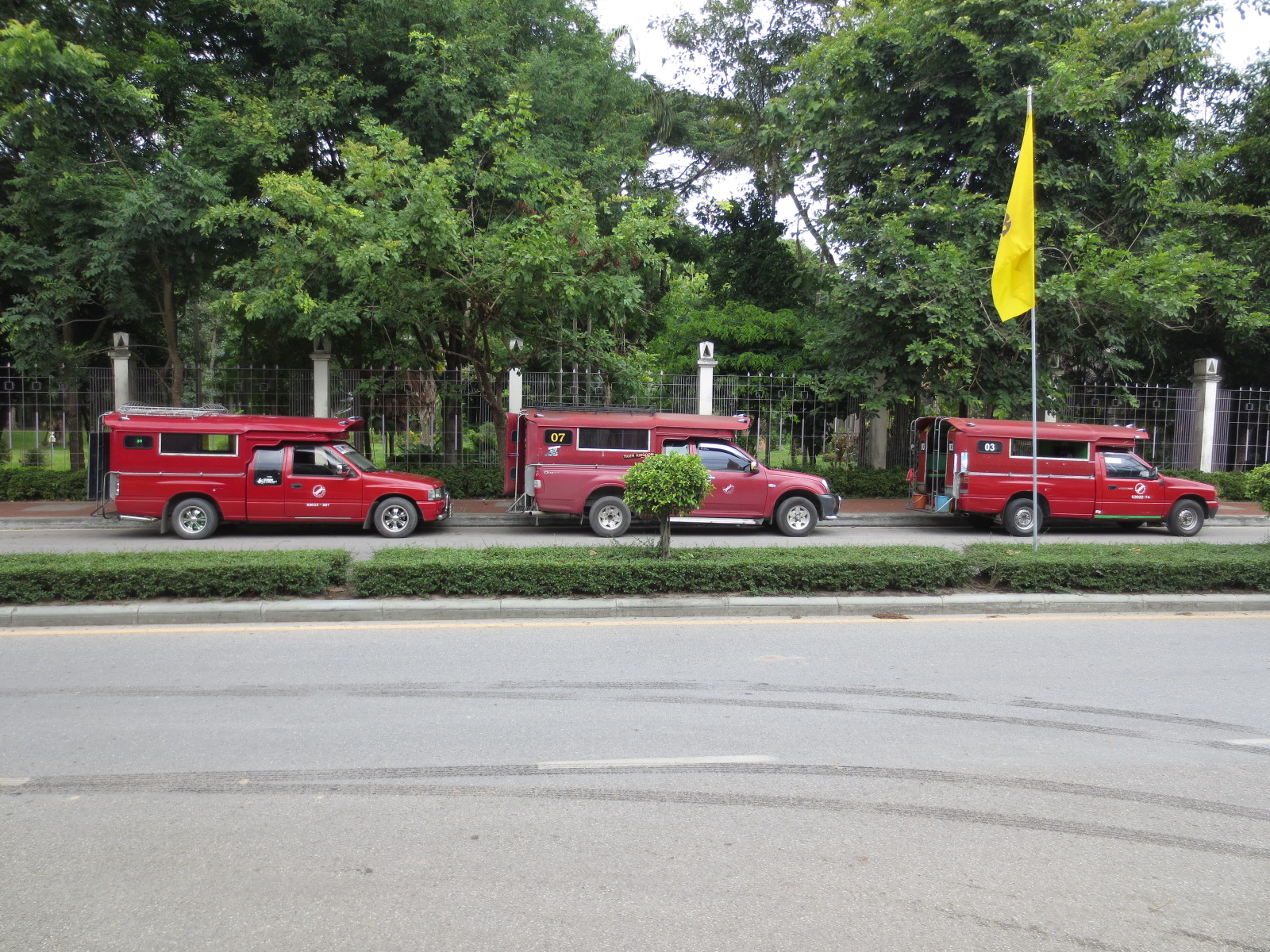
Red Taxi


I realized that I had not posted a picture of the red taxi.  Here are three of them waiting on a major boulevard for clients.  

Waiting for Customers

Carol in the back of a Red Taxi


 And this is Carol in the back of one as we were going to the Saturday Walking Street which is very much like the Sunday Walking Street.  Both feature block after block of vendors selling all sorts of products: bags hand-woven from bulrush, pottery, t-shirts, shoes, trinkets, food, purses and most anything else.  But I digress, back to the red taxis.

These guys cruise around and you wave them down, tell the driver where you want to go and agree on a price – usually 20 baht per person.  If he isn’t going in your direction, he waves you off and you find another.  You might be sharing with others or not.  He may stop to pick up others – or not.  He may take the long way around – or not.  If you decide to get off early – just push the red buzzer and he will stop and let you off.  The whole system makes a lot of sense to me.  They are officially called sorng-taa-ou but red taxi is a lot easier to say.

Friday, June 22, 2012

Royal Family

I happened on a scene today that was right out of a movie.  As I strolled into old town, some streets were blocked off.  I looked down one way and notices a line of official looking vehicles.  There were local police, Highway Patrol, and military vehicles all in a line with lots of unarmed soldiers in full dress standing around. I got a close as they would let me and took this one picture before a got a stern shake of the head.


I waited a bit, after those in the white uniforms lined the red carpet that let to a waiting car, 20 or so well dressed Thai people walked briskly to the waiting cars, opened the doors and stood by the open doors.  The solders then snapped to attention and saluted as band started playing while a person under a large purple parasol (held by someone walking behind) walked to the waiting lead car.  The solders remained at attention until the car drove down the street, did a u-turn and drove on the other side past where they standing.  Only then did they seem to relax a bit and asked one solder who that was, the king?  His English was minimal and he said "no king, but I don't know know how to say."  I pressed a bit and asked "Queen?" and he shook his head and said "daughter of king."  So, I am not completely sure, but I think I saw one of the princesses.  The entourage was certainly impressive.  In consulting my detailed map, it seems that she came out of a school for the blind.  I can only image that there was some dedication or ceremony there that she attended. 
                                                                Very impressive.


Wednesday, June 20, 2012

Settling In


Chiang Mai is a vibrant, beautiful and modern University town.  It is easy to navigate either by walking or hailing a shared “red taxi” or tuk-tuk.  Monday was orientation for the students (and professors) and then Tuesday and Wednesday were regular class days.

I had a chance to do some exploring on foot the past couple of days and have thoroughly enjoyed.  I walked in a different direction yesterday,  and using a very detailed and well documented “Nancy Chandler’s” map of Chiang Mai, I found lots of interesting eating and drinking places.  One was called Compassion Café.  The café features raw and vegetarian food – good beer and wine.  When I walked by there on Monday, it was hard to tell if it was closed for the day or forever.  I spotted a sign giving hours of operation and indeed they were closed on Monday.  Carol, Christina and I went there for dinner on Tuesday and it was incredible.  How does Vegetarian Philly Cheesesteak sound?  We split that for an appetizer and then Christina had raw Phad Tai and Carol and I both had vegetarian burgers.  I’m sure most of you know that Carol and I are devoted meat eaters but I must say this was extremely flavorful, filling and healthy to boot.  The owner/server was delightful – she was of Chinese/Thai heritage but grew up in England and had a very strong British accent.  The downer about this great find is that they will be closing the restaurant for good at the end of June due to health issues.  We will just have to go back soon to sample the remaining dishes on the menu and help them deplete their stock of BeerLao.

I had a lunch adventure on a walk to Wat Umong the next day.  Wat Umong is a temple with a tunnel.  There are many Buddhas at the end of tunnels where the ceilings are painted with – well, I really am not sure what was there.  It was quite dark and no flash photography allowed.  There were various shrines, museums and dormitories for the monks and a pond filled with fish waiting to be fed.   I saw several people buying bread at a small stand next to the pond and paying homage to the spirits by feeding the fish and pigeons.  Seems like the fish and birds really get the best end of that deal.

On the way to the Wat (rather while lost on the wrong way to the wat) I decided to stop for lunch.  There was a place that looked interesting – lots of students and even a couple of Westerners so I went in and took a seat.  I ordered Larb and soda water.  The server had some difficulty with my order even though I was pointing to my selections.  After a while, a different server came up and rattled off a question in Thai.  Getting no response from me, she called the owner over who asked if I wanted Larb.  I said yes about the same time the original server brought me a coke.  I shook my head no and told the owner I ordered soda water whereupon she looked at the server and said “soda water” which she promptly brought.  After quite a long wait, my original server brought me a dish of something that I was not expecting.  It seemed to be spaghetti in some sort of mushroom cream sauce and a glob of mayonnaise on top.  It wasn’t like any Larb I was familiar with.  I took a tentative bite and found it to be about as yucky as it looked.  I was however quite hungry so decided that I would eat some of it and chalk it up to some sort of different variety of Larb and a learning experience.  After three or four bites – server #2 appeared with a plate of what looked exactly like the Larb I was expecting.  She saw me eating this other dish, yelled at server #1, and took my plate of spaghetti away.  The real Larb was delicious and prepared me for retracing my steps and finding my way to the Wat.

There is no shortage of coffee shops here in Chiang Mai.  There is even a two-storied Starbucks.  However, we were concerned about having our morning two or three cups before breakfast.  Nescafe to the rescue.  We have a hot water pot in the room and we can get our caffeine fix while Carol preps for the day's class and I read the news on line or write blog entries.  

The internet connection at the hotel is very spotty.  It seems the head technician is in the hospital but the staff is talking to him by phone and will ask if there is anything that can be done.  I think it just needs a reset but it could be when all of the guests (students) try to access the internet at the same time with facetime, facebook, skype and you tube that the bandwidth just gives up.  Therefore, I am posting this without Carol's proofing and no pictures for now.  More illustrated posts soon.

Sunday, June 17, 2012

Chiang Mai

Even from the air you can tell that Thailand is more developed than Vietnam.  After a short stop at the Bangkok Airport we flew here and could immediately tell we were in a more developed country.  There are fewer scooters (but still lots) and the traffic is much more orderly.  There are even sidewalks that you can sort of walk on.  And even a few crosswalks where cars actually stop and let you cross the street.  We are feeling spoiled.

We checked in and found the room to be quite serviceable - after all this is listed as a hostel.  We unpacked - made a huge laundry pile and set out to explore.  We are hopeless with the street names here.  The large street near us is Nimmanhaemin Road.  We will never get even close on that one so it has become the "N" street.  We located a cafe with air conditioning on "N" street and had some great Thia food and cold Singhai beer.  We crashed and both got up this morning ready to continue exploring.

Carol met with the Thai coordinator named Krith and Christina (the other professor). They clarified a few details about the schedule and red taxi pick-up. Then off we went with Christina to explore a little more.  Lunch and a little rest got us all ready for the "Sunday Walking Street Market."

There is a great system here of the little red trucks with covered benches that you share with whoever is going your way.  You tell the driver where you are going and if that suits him, you agree on a price, usually 20 baht per person, and climb in.  20 Baht is roughly 70 cents and almost all trips around town are 20 baht.  I will post a picture of this favorite mode of transport soon.  We walked around the market and surprise! surprise! Carol found a few things to buy. [ A Carol edit: I bought ONE thing]. I even found a cool t-shirt.  Dinner at an open air restaurant recommended by an American fellow who ran a used book store and then another little red taxi ride back to our home for the next few weeks.  We ran into a few of the Cal Poly students at the market who arrived today or yesterday. They were very polite and very zombified with jet lag.

That's it until tomorrow and the official start of the program.

Observation

We all know that we Americans are larger than many other groups.  The photo shows what happens when mannequins are made to display our clothes but are used to display Asian clothes.


This was typical of so many displays that we saw - they didn't snap the waist or zip up the zipper!